Secure Document Processes for Banks and Regulated Companies
Creating a document is not the problem. The real challenge begins before and after.
For banks and other regulated companies, it is no longer enough for a document to be generated and delivered correctly. What matters is how securely and controllably the entire process is structured: who is allowed to change content, which version is approved, how changes remain traceable, and how communication can be managed consistently across all channels without increasing effort with every change.
Many weaknesses do not arise in the finished document itself, but in the process behind it. Too many templates, too many exceptions, manual approvals, and a lack of transparency about what is actually live make document processes error-prone and difficult to control.
Why banks face particular challenges here
Banks work with highly sensitive information, tight deadlines, and often very large document volumes. Account statements, interest rate adjustments, or regulatory notices must be delivered reliably, consistently, and on time. Even small errors in data transfer or processing can lead to complaints, rework, and, in the worst case, compliance issues.
On top of that, there is growing regulatory pressure. In the financial sector it's no longer enough for digital processes to simply function. They also need to be stable, secure, and traceable. That is exactly where DORA, the Digital Operational Resilience Act, comes in. DORA is an EU regulation for banks and other financial institutions. It defines how digital risks must be managed, how serious IT incidents are to be handled, how systems should be tested regularly, and how external IT service providers are to be controlled more effectively. This framework has been applied across the EU since 17 January 2025. In Austria, the DORA Implementation Act governs national enforcement by the FMA.
Where document processes become difficult in practice
The challenge usually does not lie in the individual document itself, but in the many exceptions and variations within the process. Different templates for different channels, local adaptations in individual departments, and lengthy coordination cycles mean that even minor changes become unnecessarily complex. The more variants and exceptions emerge, the harder it becomes to maintain communication that is both consistent and controlled.
In addition, document processes in banks rarely operate in isolation. Data comes from core banking systems, CRM platforms, and customer portals. Content has to be transferred correctly, reviewed, approved, and then delivered across multiple channels. Whenever media disruptions or unclear responsibilities occur at these handover points, both effort and risk increase immediately.
Central template management reduces effort and risk
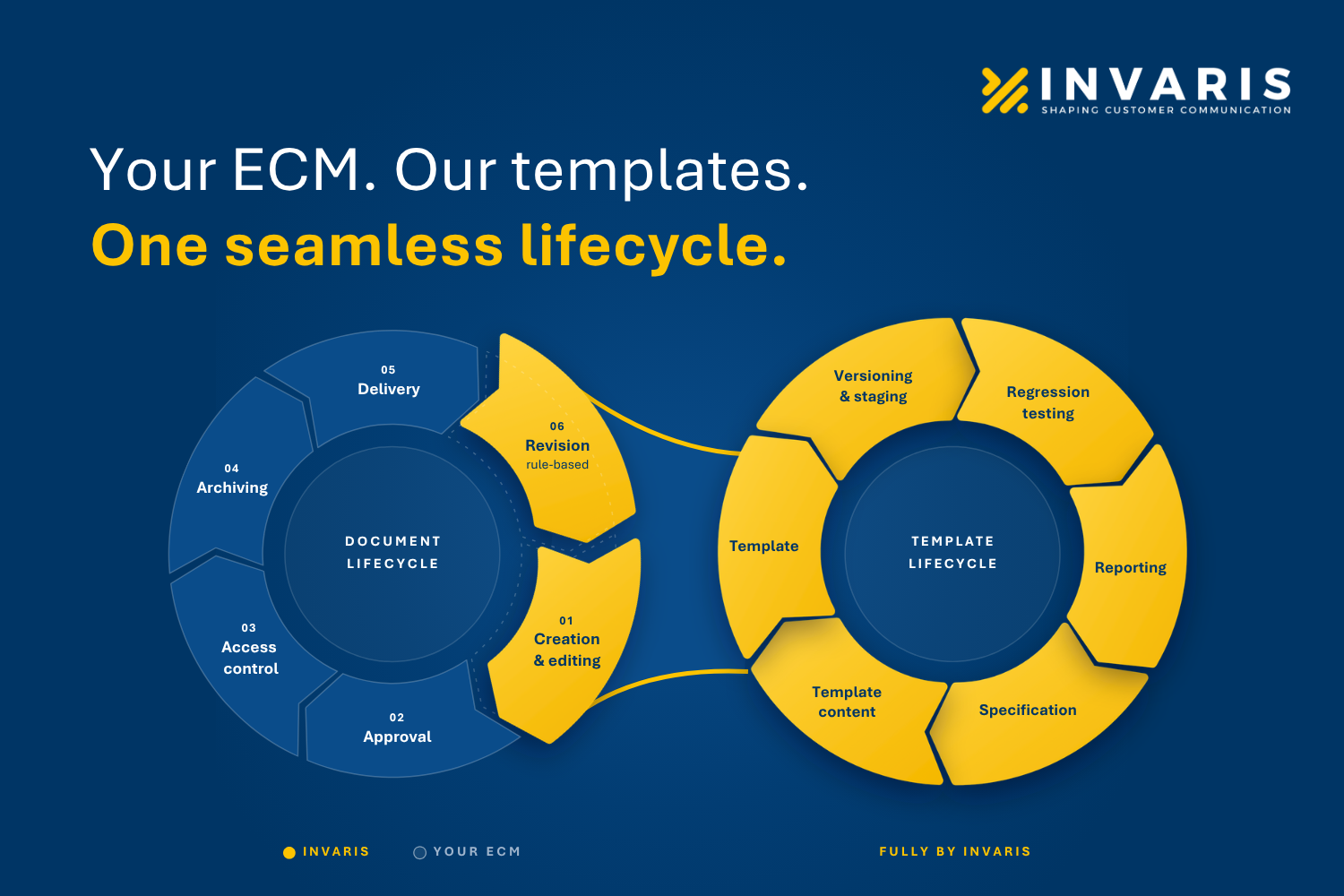
One of the biggest levers lies in template logic. If templates, text modules, graphics, and resources are maintained separately in different places, every change creates additional effort. At the same time, the risk increases that content becomes inconsistent or that outdated versions remain in circulation.
This is exactly where central template management makes a difference: through consistent template maintenance, versioning and controlled approvals across all channels. For business departments, it is especially important that templates can be managed graphically and without programming, while still maintaining control over central standards.
Traceable changes provide security in day-to-day operations
In regulated organizations, it is not enough for content to be correct. It must also be clear how that content came into being. Who made a change? Which version was active? What was approved? These questions become increasingly important when business departments, IT, compliance, and internal audit are all looking at the same process.
Traceable changes are therefore relevant not only for audits, but also for day-to-day operations. When responsibilities and statuses are clear, coordination effort decreases and operations become more stable.
Clear roles and controlled access
Secure document processes depend heavily on how responsibilities are defined. If too many people can make changes at too many different points, uncertainty and inconsistency quickly arise. A clearly defined role model is therefore not an optional extra, but a basic requirement.
The benefit lies not only in technical security, but also in clear responsibilities. For regulated companies, that is exactly what matters: data and content must remain protected without limiting the ability of business departments to work efficiently.
One template for multiple channels
A common cost driver in customer communication is duplicate maintenance. As soon as the same content is managed separately for print, portal, app, or archive, the effort multiplies with every change. In regulated environments, this is particularly problematic because adjustments have to be reviewed and rolled out multiple times.
An effective document process therefore ideally relies on a central template logic for multiple output channels. This reduces duplicate maintenance, improves consistency, and makes changes significantly easier to manage.
Interactive processes closer to business applications
Not every document process is a pure batch process. Many processes in banks are interactive: applications, amendments, individual correspondence, or structured data capture. This is often where media disruptions occur, especially when document processing and business applications do not work together seamlessly.
A browser-based approach can simplify this considerably. When document processing and online forms are embedded directly into existing systems, processes stay closer to the actual business workflow. This makes work easier for case handlers, reduces rework, and ensures that users do not experience the process as a separate external system.
Why this is not just a compliance issue
DORA increases the pressure to act, but secure document processes are not just a reaction to regulation. They are also an operational advantage. Fewer template variations, clearer approvals, less reliance on IT for standard changes, and consistent communication across multiple channels make processes faster and more robust.
For banks and other regulated companies, this is therefore not only about meeting requirements. It is about building document processes that work in day-to-day operations, remain stable when changes occur, and continue to perform under high volumes.
Conclusion
Secure document processes are not created by adding more tools, but by creating more clarity. Those who manage templates centrally, regulate access properly, make changes traceable, and run multiple channels from a single logic create better conditions for stable communication in regulated environments.
For banks and other regulated companies, this is becoming increasingly important. Not only because of DORA, but because document processes are now much more closely tied to risk, efficiency, and operational control. A central and controllable solution for templates, processes, and output helps to reduce complexity and make document processes more manageable in daily operations.
Would you like to make your document processes easier to control and identify where unnecessary complexity arises today? Then talk to us about central template management, auditable approvals, and secure communication in regulated environments.