Output Management for ECM Systems: From Document Management to Complete Document Processes
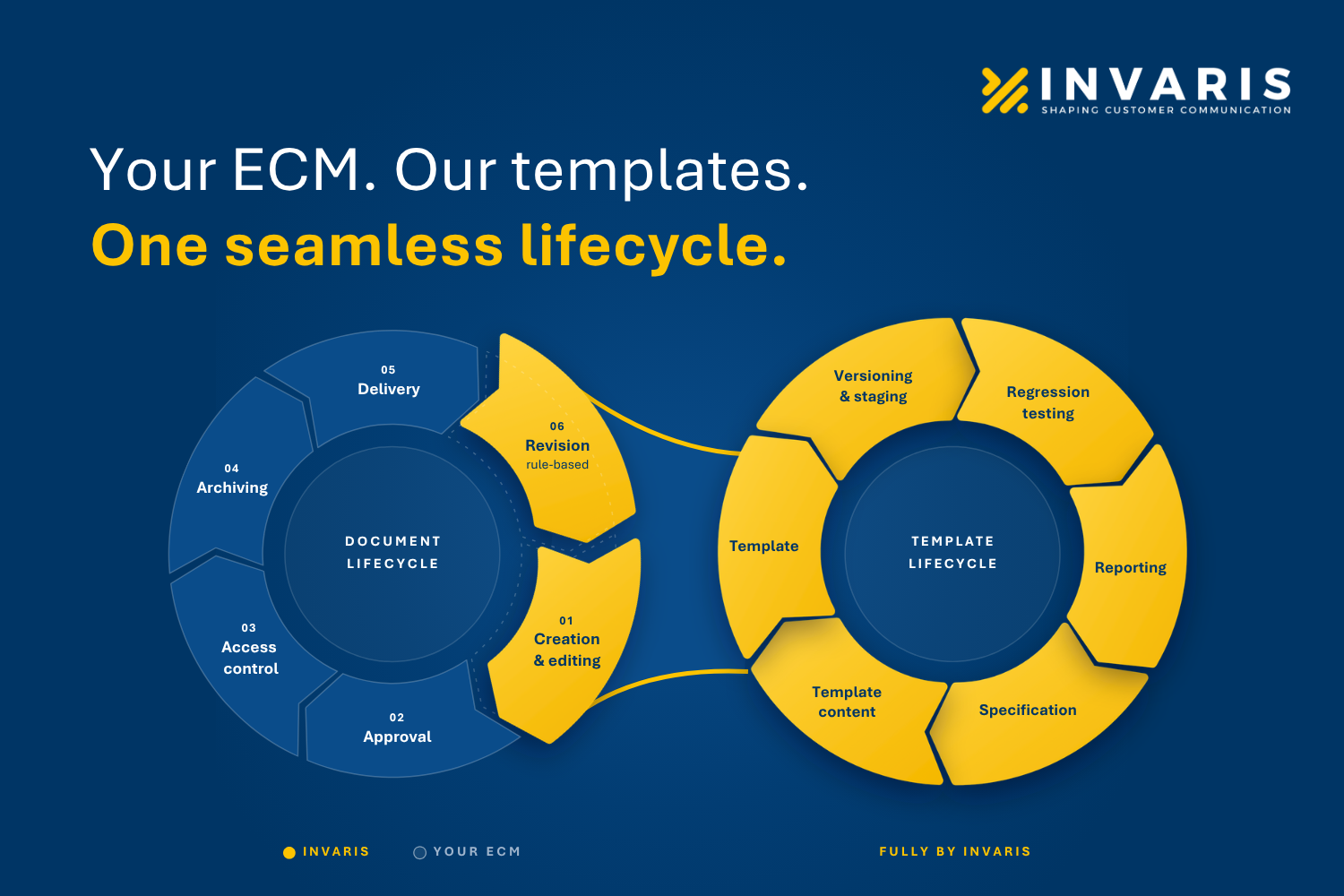
Customers generally do not distinguish between ECM and output management; they view the document lifecycle as a whole. Since document templates are usually recreated or migrated during an ECM implementation, they often expect services for the initial creation and migration of templates in addition to integrated output management functionality.
The ECM vendor's decision to leave the choice of output management system to the customer may define their own scope of responsibility, but it does not align with customer expectations. This simply pushes the challenge to a later stage, whether during the purchasing process or the subsequent project implementation.
When simple requirements turn into complex document processes
This difference in perspective between the customer and the ECM vendor creates several practical challenges. Customers often expect support not only with the migration of their templates but also with their ongoing maintenance and further development.
For individual letters, Word templates or simple template functions are often perfectly sufficient. However, as needs grow, so do the functional and technical requirements. Additional input data needs to be captured, text modules selected based on the specific process, and document variants assembled automatically.
These requirements are often initially addressed using VBA macros or custom extensions. This gradually creates an increasingly complex solution that requires specialized knowledge to maintain. At some point, these solutions become difficult to maintain and scale.
To better handle the creation of mass documents, additional reporting tools like Crystal Reports or BIRT are frequently used. This results in a heterogeneous template and system landscape that increases maintenance efforts. Each of these different tools requires specific expertise and often leads to redundant content within the template base.
With customer-specific systems, there is the added challenge of having to integrate them individually with the ECM system in every project. Providing output management functionality through the ECM vendor avoids this integration effort, reduces the number of systems involved, and significantly lowers the complexity and risk of the implementation project.
Why this matters for ECM vendors
ECM vendors can, in principle, leave the choice of output management solution to the customer. In practice, however, the technical and organizational responsibility rarely remains entirely with the customer.
At the latest when questions arise regarding integration, updates, new document requirements, or unclear responsibilities, the ECM vendor is often brought back into the fold. The ECM vendor still ends up investing time and resources.
By contrast, with a pre-defined and proven output management solution, the ECM vendor retains more control over integration, responsibilities, and further development. Customers receive a coordinated, end-to-end solution, responsibilities are clear, and new features can be implemented in a structured, collaborative manner.
Integrated output management for ECM systems
These challenges can be avoided through the coordinated interaction between enterprise content management and output management. ECM vendors can offer their customers the entire document lifecycle from a single source without having to invest in the development and maintenance of their own document creation solution.
INVARIS complements the ECM system with powerful output management and customer communication management, designed to be seamlessly integrated into business applications like an ECM system. Customers get a seamless end-to-end solution for creating, editing, distributing, and managing documents, all within a consistent user experience
Additionally, INVARIS offers the LayoutFactory Service, a flexible service offering for the creation and maintenance of templates. Customers can use this service to accelerate template migration or outsource the ongoing maintenance of their templates to INVARIS. Since INVARIS specialists focus exclusively on the development and maintenance of document templates, proven procedures using INVARIS products and best practices from numerous projects are incorporated directly into the implementation. This reduces project and maintenance costs, increases template quality, and sustainably lowers project risk.
Your benefits as an ECM vendor
For ECM vendors, this means more sales opportunities, less internal effort, and lower product risk
- Greater competitiveness in document-intensive tenders by covering the entire document lifecycle
- Faster purchasing decisions through a complete solution offering from a single source
- Generate additional revenue through OEM or partner agreements
- Offer template services (LayoutFactory) without having to build specialized in-house expertise
- Secure your long-term document strategy without investing in your own product
A partnership, not an add-on
Instead of leaving the choice of document creation entirely open and having your service department handle subsequent requirements, INVARIS offers you a path for cooperation and integration with clear responsibilities from the very beginning.
This significantly reduces the need for coordination between different providers and compatibility checks during updates. It lowers project risks, relieves the burden on your teams, and provides long-term security for both you and your customers.
How integration with INVARIS works
INVARIS is integrated directly into your existing ECM processes. The necessary data and context information are pulled from the ECM system or a connected business application. INVARIS then handles the creation, editing, and output of the documents.
Technical template logic is maintained by trained template developers or your IT department. This ensures that the required knowledge remains structured and accessible, rather than being tied to individual employees or legacy macro solutions.
Frequently Asked Questions
What is the difference between ECM and Output Management?
An ECM system manages documents, metadata, permissions, workflows, and archives. Output Management handles the professional creation, assembly, and output of documents. Both disciplines complement each other to form a seamless process.
When does Word reach its limits as a template tool in an ECM?
Word can be well-suited for individual, simple documents. However, as soon as reusable content, business rules, input forms, or automatically assembled document variants are required, VBA macros are often necessary.
Furthermore, Word only covers important requirements for template governance to a limited extent. This includes, for example, the traceability of changes, regulated approval processes, and clearly defined responsibilities. Such functions are usually an integral part of a professional output management solution.
As an ECM vendor, do I need to develop my own CCM solution?
No. Through a partnership with a specialized provider, you can offer professional document creation without permanently tying up your own development, maintenance, and support resources.
Conclusion
You can focus on your core ECM competencies while simultaneously offering your customers a professional platform for all their document communication. With a well-established output management partnership, you bridge the gap between creation and management, strengthen your position in tenders, and create a reliable solution path for growing customer requirements.
INVARIS brings around 40 years of experience in Output Management and Customer Communication Management. Would you like to see how this can be integrated into your ECM solution? Talk to us about requirements, integration scenarios, and partnership models.